August 24, 2026
Milk Nutrition Facts: What’s Actually in a Glass of Milk?
Key Takeaways
Milk includes a combination of macronutrients and micronutrients, including protein, carbohydrates, fat, calcium, vitamin D, potassium, B vitamins, phosphorus, and water.
An 8 oz glass of traditional milk typically provides about 8 grams of high-quality protein, while fairlife® ultra-filtered milk provides 13 grams of high-quality protein per serving.
The Nutrition Facts label can help you compare milk ingredients and key nutrients in milk, including calcium, vitamin D, potassium, and protein per serving.
fairlife ultra-filtered milk is lactose-free and has 50% more protein and 50% less sugar than regular milk.
Jump To:
- What Milk Nutrition Facts Tell You About Each Serving
- Understanding the Nutrition Facts Label
- The Essential Nutrients in Milk
- Why Are Milk’s Nutrients So Important for Your Health?
- What makes fairlife ultra-filtered milk different?
- Frequently Asked Questions
What Milk Nutrition Facts Tell You About Each Serving
Milk is more than just a source of protein. An 8 oz glass contains a variety of essential nutrients, including protein, calcium, vitamin D, potassium, carbohydrates, fat, and water. Understanding milk nutrition facts can help you make informed choices about how milk fits into a balanced diet.
Whether you’re comparing milk products, wondering what vitamins are in milk, or trying to understand how much water is in dairy milk, here’s a closer look at the nutrients that make milk a nutrient-rich beverage—and how to read the information on a Nutrition Facts Label.
Understanding the Nutrition Facts Label
Every packaged milk product includes a Nutrition Facts Label that provides important information about what’s in each serving. Learning how to read that label can help you compare milk products, review milk ingredients, and better understand how each serving contributes to your daily nutrition goals.
When reviewing a Nutrition Facts label, pay attention to these four key sections:
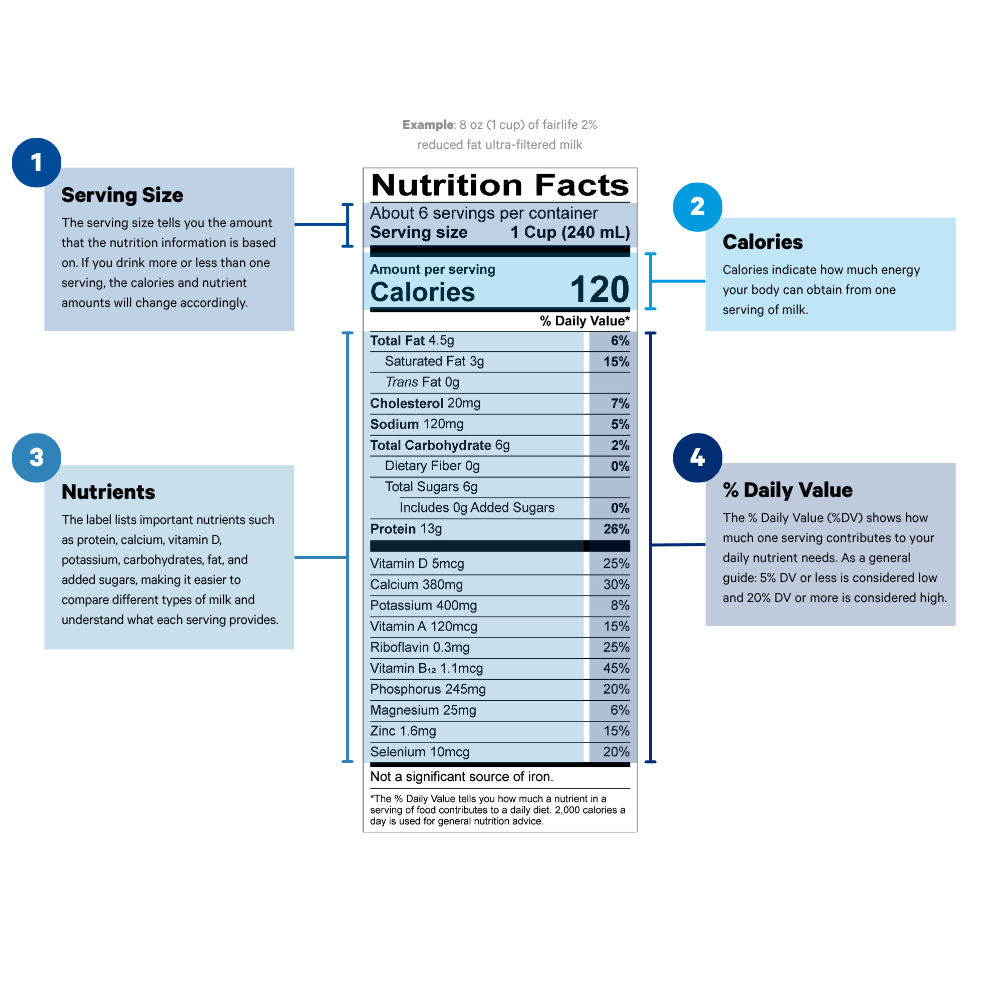
- Serving Size: The serving size tells you the amount that the nutrition information is based on. If you drink more or less than one serving, the calories and nutrient amounts will change accordingly.
- Calories: Calories indicate how much energy your body can obtain from one serving of milk.
- Nutrients: The label lists important nutrients such as protein, calcium, vitamin D, potassium, carbohydrates, fat, and added sugars, making it easier to compare different types of milk and understand what each serving provides.
- % Daily Value (%DV): The % Daily Value (%DV) shows how much one serving contributes to your daily nutrient needs. As a general guide: 5% DV or less is considered low and 20% DV or more is considered high.
This simple guideline can help you quickly identify whether a serving of milk is a low- or high-source of a particular nutrient.
Sources: U.S. Food & Drug Administration. “How to Understand and Use the Nutrition Facts Label” and “Using the Nutrition Facts Label to Choose Milk and Plant-Based Beverages.”
The Essential Nutrients in Milk
The nutrient content of milk can vary slightly depending on the type of milk you choose. Here’s how one 8 oz serving of whole milk and one 8 oz serving of ultra-filtered whole milk compare for common milk nutrition facts, including protein in milk, calcium in milk, vitamin D, potassium, carbohydrates, and fat.*
Just one serving of milk provides multiple essential nutrients that can contribute to a healthy eating pattern.
| Nutrient | Whole Milk | Ultra-Filtered Whole Milk | Approx. % Daily Value* |
| Calories | 150 | 150 | — |
| Protein | 8 g | 13 g | 16% / 26% |
| Total Fat | 8 g | 8 g | 10% |
| Carbohydrates | 12 g | 6 g | 4% / 2% |
| Total Sugars | 12 g | 6 g | — |
| Calcium | ~300 mg | ~380 mg | 25% / 30% |
| Vitamin D | ~1.3 mcg | ~5 mcg | 10% / 25% |
| Potassium | ~350 mg | ~400 mg | 8% |
| Vitamin B12 | ~1.3 mcg | ~1.1 mcg | 55% / 45% |
| Riboflavin (Vitamin B2) | ~0.45 mg | ~0.25 mg | 35% / 20% |
| Phosphorus | ~230 mg | ~270 mg | 20% |
*Approximate values based on a typical 8 oz serving. Nutrition values and % Daily Values may vary by product. Always refer to the Nutrition Facts label for the most accurate information.
Why Are Milk’s Nutrients So Important for Your Health?
Milk contains a combination of macronutrients and micronutrients that contribute to its nutritional profile. Macronutrients include protein, carbohydrates, and fat, which the body needs in larger amounts for energy and daily function. Micronutrients, such as calcium, vitamin D, potassium, phosphorus, and B vitamins, are required in smaller amounts and help support many important functions throughout the body.
Together, these nutrients make milk a nutrient-dense beverage that can contribute to a healthy eating pattern. Let’s break it down:
Protein
An 8 oz glass of traditional milk typically contains about 8 grams of high-quality protein. Milk protein is considered a complete protein because it contains all nine essential amino acids.
Protein in milk helps build and maintain muscle while supporting many important functions throughout the body.
Some milk products contain more protein than traditional milk. For example, fairlife ultra-filtered milk contains 13 grams of high-quality protein per serving. Learn more about fairlife ultra-filtered milk.
Calcium
Milk is one of the best-known dietary sources of calcium. An 8 oz serving typically provides about 25% of the Daily Value for calcium. Calcium is one of the nutrients many people look for on the Nutrition Facts label when evaluating their dairy consumption.
Calcium helps build and maintain strong bones and teeth while supporting normal muscle and nerve function.
Vitamin D
Many milk products are fortified with vitamin D, an important nutrient that helps the body absorb calcium. If you’re wondering how much vitamin D is in cow milk, check the Nutrition Facts label, as the amount can vary by product.
Together, calcium and vitamin D support bone health. The amount of vitamin D can vary by product, so it’s always a good idea to check the Nutrition Facts label.
Potassium
Milk naturally contains potassium, a mineral that supports normal muscle and nerve function. Potassium also helps maintain normal fluid balance in the body.
Checking the Nutrition Facts label can help you compare the potassium content of different milk products.
B Vitamins
Milk contains several B vitamins, including vitamin B12 and riboflavin (vitamin B2).
Vitamin B12 helps support nerve health and the production of red blood cells, while riboflavin helps convert food into energy. Together, these vitamins contribute to milk’s overall nutritional value.
Water
Many ask how much water is in dairy milk, and the answer is that milk is mostly water—about 85–90% of an 8 oz serving.
This high water content contributes to milk’s smooth texture while helping deliver the nutrients found naturally in milk.
What Makes fairlife ultra-filtered milk Different?
fairlife ultra-filtered milk starts with real dairy milk and uses an ultra-filtration process to concentrate protein and calcium while reducing sugar. It is also lactose-free.
Compared to traditional milk, fairlife ultra-filtered milk contains 13 grams of high-quality protein per serving and 50% less sugar, along with calcium, vitamin D, potassium, and other nutrients found in milk.
Learn more about fairlife ultra-filtered milk.